Find out what real clients
have to say

Over 44,000 People in Switzerland Have Used the
Swiss Property Owners Association to Achieve Better
Results in Buying or Selling Their Home

Find out what real clients have to say

Over 44,000 People in Switzerland Have Used the Swiss Property Owners Association to Achieve Better Results in Buying or Selling Their Home

What is the Lex Koller – a brief explanation

The Lex Koller, officially the Federal Act on the Acquisition of Real Estate by Persons Abroad (BewG), has, since the 1980s, restricted who is permitted to acquire real estate in Switzerland. In principle, ‘persons abroad’ require a cantonal authorisation to purchase residential property. Propertyowner.ch has already reported on this: Lex Koller – a strict reputation, a relaxed reality.
Anyone who is lawfully resident in Switzerland and holds a valid residence permit is currently not generally regarded as a “person abroad” and may purchase a main residence without requiring authorisation – regardless of their nationality. It is precisely this point that the planned tightening of the law addresses.

An overview of the key planned changes:

New permit requirement for third-country nationals without a settlement permit: This is the change with the greatest implications for foreign nationals living in Switzerland. Third-country nationals – that is, people from countries outside the EU/EFTA – without a permanent residence permit (C permit) will once again require authorisation to purchase a main residence. This permit requirement for third-country nationals residing in Switzerland had previously been abolished; the bill provides for its reintroduction. Citizens of EU and EFTA states are not affected by this tightening of the rules, as the Agreement on the Free Movement of Persons applies to them. People with a C settlement permit – regardless of their nationality – will also remain exempt.

Ban on listed residential property: In future, people living abroad will not be permitted to acquire either shares in listed residential property companies or regularly traded units in property funds. Until now, foreign investors have been able to gain access to the Swiss residential property market via the stock exchange without being subject to the existing Lex Koller regulations. This loophole is to be closed.

Commercial property exempt from authorisation only for own business use: Purchases of commercial property by persons residing abroad will only be exempt from the authorisation requirement if the property is used for their own business. Purely financial investments would therefore now require authorisation.

Halving of holiday home quotas: The quotas within which non-residents may purchase holiday homes are to be halved.

Relief for staff accommodation in hotels: As a counterbalance to the tighter restrictions, the bill implements a motion by Council of States member Martin Schmid (FDP/GR): hotels owned by persons resident abroad are to be able to build or acquire staff accommodation more easily. In future, these will be regarded as part of the business premises and will therefore be exempt from the Lex Koller – a measure to help tackle the shortage of skilled workers in tourist regions.

What is the status of the political process – and when could the stricter measures come into force?

The consultation on the revision ran from 15 April to 15 July 2026. During this phase, cantons, political parties, associations and other interested parties were able to submit their official comments. The feedback was wide-ranging: practically the entire spectrum was represented, from clear approval to sharp criticism from business associations and parts of the property sector.

Next, the relevant department will evaluate the comments received. On this basis, the Federal Council will decide how to proceed with the bill and will subsequently adopt a dispatch for Parliament. The National Council and the Council of States will then debate the bill, usually in several readings with the resolution of differences, before a final vote takes place. An optional referendum may be called against the adopted law; should this happen, the electorate will decide at the ballot box.

There is currently no specific date for the law to come into force – nor can there be at this stage, given the ongoing procedure. Experience shows that such controversial legislative amendments take several years from the consultation phase to their final entry into force, particularly if differences of opinion or a referendum are to be expected in Parliament. Until then, the current Lex Koller will continue to apply unchanged.

What does this mean for you as a property owner?

For the time being, nothing is changing from a legal perspective. Anyone who currently owns, wishes to sell or purchase residential property can continue to follow the provisions of the current Lex Koller.

The Swiss Property Owners’ Association is monitoring the ongoing legislative process and will provide updates on propertyowner.ch as soon as the Federal Council adopts its message to Parliament or there are further decisive procedural steps.

Sources
cash.ch (Ringier Media Switzerland, AWP agency): ‘Tighter Lex Koller polarises politics and business’, 15 July 2026
https://www.cash.ch/news/top-news/verscharfte-lex-koller-polarisiert-politik-und-wirtschaft-953201

– GMX.CH News (sda news agency): “Federal Council’s plans for the Lex Koller are causing divisions”, updated on 15 July 2026
https://www.gmx.ch/magazine/schweiz/bundesratsplaene-lex-koller-sorgen-frontenbildung-42505960

Definition:

The real value of a property is based on a simple assumption: a buyer today will only pay as much for a property as they would have to pay for the purchase of the building plot and the construction of the building. Accordingly, two elements are crucial: the land value and the current market value of the building.

When is the real value method used?

The real value method (commonly referred to as the asset value or net asset value method) is used for properties where there are few comparable properties and where the value is not determined by rental income. This therefore applies to owner-occupied properties which are, however, so unique in nature that there are hardly any comparable properties available. The real value method is also suitable for so-called ‘collector’s items’ with many distinctive features.
Examples include a rustico in Ticino, a remote, converted farmhouse in the Alps or a flat in a listed castle.

How is the real value calculated?

To calculate the real value, experts use the following formula:

New-build costs + land value – depreciation due to age = real value

The individual components of the formula are calculated as follows:

  1. New-build costs
    Firstly, the cost of constructing the same building from scratch is calculated. The construction costs for the building are determined by applying a reference price per cubic metre of volume. In most cases, the reference price is derived from the Building Cost Plan (BKP), which was developed by the Swiss Central Office for Building Rationalisation (CRB). In addition to the price per cubic metre for the building itself, ancillary construction costs (including planning and design costs, site development costs, financing costs, and administrative and processing costs) and the costs of site works must also be taken into account.
  2. Land value
    When using the real value method, the value of the building plot is usually determined using statistical data per square metre from price comparison services such as Wüest Partner, IAZI or Pricehubble. It should be noted, however, that these values are relative, as they do not take into account the specific usability of the plot.In addition, the land value must take into account the demolition costs for the existing building.To value building land, experts recommend the residual value method, which is also used by the Swiss Landowners’ Association.
  3. Age -related depreciation: Age-related depreciation is calculated by first determining the refurbishment cycle of each part of the building, i.e. the average time span until complete renewal. The technical age of the building – the average of the differences between the service life and the remaining useful life of the individual parts of the building – can be used to determine the extent to which the building is already ‘worn out’. The timing of the next cyclical refurbishment indicates when renewal will be required. Based on the proportion of the respective renewal costs relative to the total value and the duration of the refurbishment cycle , the annual depreciation due to age is calculated, which reflects the building’s annual loss in value.

What other valuation methods are there?

Provided there are sufficient comparable properties – as is usually the case with detached houses and flats – hedonic models (the comparative value method) are used in most instances.

For investment properties, the value is determined using the income approach or the discounted cash flow method. These methods focus on current and future annual rental income and the expected annual return for a potential buyer.

As already mentioned, the residual value method should be used for building land. With this method, a project study is used to determine the realisable potential (number of buildable units and square metres of floor area), which is then valued. The expected construction costs, including the contractor’s profit and risk, are then subtracted from this value, resulting in the final land value.

A comparison of the main valuation methods

Real value Hedonic Residual DCF /
Income value
Short definition New construction costs + land value – age-related depreciation Value based on comparable data from similar properties (statistical model) Land value = project value – construction and ancillary costs Value = discounted future income (cash flows)
Suitable property types Special properties, unique properties, few references Apartments, single-family homes, solid base of comparable properties Building land Apartment buildings
Advantages The substance of the building is taken into account Market potential is optimally considered Calculation based on the optimal use of the plot Current and future cash flows are considered, sustainable approach
Disadvantages The market (supply and demand) is not sufficiently considered Limited reliability when there are few comparable properties Very time-consuming; a project study is essential Very complex calculation; discrepancy between target and actual rents

Conclusion

The real value method is an indispensable tool in property valuation. It is always used when comparative values are lacking or when rental income does not provide a reliable basis. Particularly in the case of unique or highly customised properties, it enables an objective and transparent valuation. Despite its limited scope of application, it remains essential for experts – not so much as a standard method, but rather as a precision tool used in specific situations.

The sale of building land proves particularly challenging – that is, not the traditional detached house, but undeveloped plots or properties with existing buildings and untapped development potential. This requires not only a keen sense of the market, but also sound knowledge of construction. It is precisely at this point that professional advice makes all the difference.

Sell or build on the land yourself?

If you are the sole owner, this decision is relatively straightforward. In the case of a community of heirs, however, the whole group must reach a consensus – a challenge that should not be underestimated.

In any case, the first step is to make a fundamental decision: Can I imagine living on this plot of land? Do I have the determination, the courage, the energy and the necessary resources – not just financially, but also in terms of time – to build a new home? Anyone who answers this question with a clear ‘no’ can move straight on to the selling process.

If the decision depends on financial circumstances, it is worth obtaining a professional property valuation. The residual value method, recommended by experts, kills two birds with one stone: A potential building project is outlined, and the property value is derived from this, taking into account the income value and construction costs. The result provides both a realistic estimate of the new-build costs and the current market value in the event of a sale – a solid basis for an informed decision.

The Swiss Landowners’ Association offers such a property valuation free of charge.

Step-by-step guide to selling a plot of land

The decision has been made: the property is to be sold. What is the best way to proceed?

Clarify your priorities
The first step is to ask yourself what your priorities are: what is really important to me as the seller? Possible answers might include:

  • I want to get the highest possible price – I don’t mind who buys the property.
  • It is important to me that the property remains in familiar hands and, if possible, goes to relatives or acquaintances.
  • I want the property to continue to be used in much the same way as before – whether for emotional reasons, such as family history attached to it. Large-scaledevelopment is out of the question for me.

If the highest price isn’t the main priority, it may be sensible to initially discuss the forthcoming sale discreetly amongst friends and family. However, caution is advised: experience shows that such information spreads quickly, and suddenly you’ll be contacted not only by acquaintances but also by estate agents in droves. In this case, too, it may be worth engaging an estate agent who can specifically advocate for your preferences.

On the other hand, if you’re aiming for the best possible price – and this is usually the case – professional support is essential.

Assessing marketability
Before the actual sales process begins, it is important to establish whether the plot is even marketable. Several factors play a role here:

  • The size of the plot – it is hardly possible to build a house on a plot of just 100 m².
  • The type of zoning – building zone, core zone, agricultural zone, etc.
  • Any entries in the land register, such as restrictions on sale or building.
  • The current hazard map.

Much of this information can be found in the ÖREB cadastre. ÖREB stands for ‘public-law restrictions on ownership’ and is publicly accessible via Cadastre.ch, for example. The extract contains, amongst other things, details of the building zone, the plot size, hazard zones, any development plans and building lines.

In addition, it is advisable to check the land register extract, which is available from the relevant land registry office. If the land register contains, for example, a restriction on disposal, this must be removed before the sale – otherwise the property is legally considered non-transferable.

As many of these documents are difficult for laypeople to understand, it is advisable to seek professional assistance at this early stage.

Obtaining documents
Potential buyers absolutely must have the following documents to make their decision:

  • Land registry extract
  • ÖREB extract
  • Municipal building regulations
  • Wording of easements and encumbrances (restrictions on disposal, building restrictions such as rights to build adjacent to the property, etc.)
  • Any applicable development plans
  • Hazard map
  • Depending on the plot, further plot-specific documents

Determining the sale price
A fair market value and plausible sale price can be determined on the basis of a professional property valuation. How such a valuation works is explained further down in the article.

When is the right time to sell?

Contrary to popular belief, there is no ideal time of year to sell a plot of land. In the competitive Swiss property market, there are prospective buyers ready to purchase in most locations throughout the year.
However, it makes sense to keep an eye on interest rate trends: low interest rates improve financing conditions for buyers and have a positive effect on the price you can achieve. If a rise in the base rate is expected in the foreseeable future, it may be worth not delaying the sale unnecessarily.

Sales strategy: on-market or off-market?

The priorities established earlier play a decisive role in determining the sales strategy. An off-market strategy – that is, foregoing a public listing in favour of discreet marketing within your existing network – can make sense in certain situations. However, anyone aiming for the highest possible price would be ill-advised to use this method: it simply does not reach all potential buyers.

Practical tip: Many estate agents claim to already know a suitable buyer within their network. However, the likelihood that this buyer is actually a good fit for the specific property is low. Such claims should always be viewed with a critical eye.

A listing within an internal network may, at best, make sense as a supplementary measure for a limited period. For price optimisation, however, a public listing with maximum visibility remains the superior tool: the more potential buyers are reached, the greater the variety of offers – and the higher the achievable sale price.

Attractive, professional sales documentation is essential for successful marketing. When it comes to plots of land, the aim is to demonstrate the potential of the plot to prospective buyers – ideally with a feasibility study drawn up by architects and appealing visualisations of a possible construction project. A single photograph of the undeveloped plot, by contrast, is not very convincing.

When it comes to pricing, there are also two approaches to choose from: the price is communicated transparently in the advert, or it is listed as ‘price on application’. The latter is often interpreted in professional circles as a sign of an inflated price. Those who opt for a professional valuation have a plausible, justifiable price – and therefore nothing to hide. Transparency builds trust among buyers and reinforces the credibility of the listing.

Start the sales process

Once the strategy, priorities and pricing have been clarified, the actual sales process can begin. Following the listing, you will hopefully receive enquiries from numerous interested parties.

It’s important to note that enquiries regarding plots of land are far more complex than those for flats or houses. Instead of questions about the flooring in the children’s bedroom, topics such as the cancellability of a water rights licence or detailed provisions from the building regulations suddenly come to the fore. Price negotiations are also more challenging, as you are often dealing with professional buyers who are tactically savvy – offers are deliberately made or withdrawn to exert pressure.

Anyone selling a plot of land on their own must be aware of this complexity. And that’s not all: there’s also the choice of the right notary’s office, the legal review of the contract of sale, ensuring the reservation process is carried out correctly, and dealing with tax issues.

How do I determine the ideal selling price?

As mentioned several times in this article, there is no getting round the need for a reputable, professional property valuation. The linked article on property valuation explains exactly how this works .

Common pitfalls when selling property

Mistakes when selling land can prove costly. The most common ones are:

Unprofessional sales documentation: Buyers are unable to form a clear picture of the plot’s potential – and banks lack a solid basis for their financing assessment.

Lack of market knowledge and negotiating skills: Land in sought-after locations is highly competitive. Professional property developers and institutional investors are on the lookout for bargains – and ill-informed private sellers are easy prey. Purchase offers should therefore always be reviewed by an independent expert.

Overly high asking prices: A plot of land that remains on the market for too long at an unrealistic price becomes a slow-moving property. Subsequent price reductions are then of little help – the property has been ‘burned’.

Overconfidence: Even well-informed and committed private individuals underestimate the effort involved in such a transaction. The flood of emails containing complex questions about buildability, encumbrances, hazard maps or financing details can quickly overwhelm even experienced sellers.

Failure to secure commitments: The building land market also attracts dubious prospective buyers. They submit supposedly binding offers – only to pull out shortly before the contract is signed. The seller is then left to foot the notary’s fees. Therefore, the rule is: always work with deposits, reservation agreements, financing confirmations and irrevocable payment undertakings.

Which buyer groups are suitable?

This depends heavily on the plot’s suitability for development. Smaller plots in single-family residential areas generally attract private households. Where plots are suitable for a block of flats, professional property developers and institutional investors – such as pension funds – quickly come onto the scene.

Given the political trend towards denser development, multi-family homes are now possible even on smaller plots. Even a standard detached house with an appealing footprint can thus become an attractive building plot – and appeal to a correspondingly broad range of buyers.

What costs are involved in selling a plot of land?

The following overview shows the main cost items:

Cost type Amount
Notary fees Up to 0.8% of the transaction value
Land registry fees 0.1% to 1% of the transaction price
Real estate transfer tax (varies by canton) 1.0% to 3.3% of the transaction price
Land value levy (in case of rezoning) 20% to 40% of the land value increase
Property gains tax Varies depending on the gain, holding period and deductions
Brokerage fees Usually around 5% of the achieved sale price
Conclusion

Selling a plot of land is significantly more complex than selling a flat or a detached house. In addition to legal, tax and structural issues, the correct valuation, a well-thought-out sales strategy and professional sales documentation play a crucial role.

Anyone who sells their plot of land below its value or neglects important checks risks significant financial losses. Conversely, careful preparation pays off: it helps to achieve the best possible price and ensures the entire process is handled efficiently and in compliance with the law.

Particularly in the case of building land or plots with development potential, it is worth consulting experienced specialists at an early stage. Professional guidance provides certainty, reduces risks – and helps to realise a plot’s full potential.

I

Complex reform with transition period

The reform will completely abolish the imputed rental value – a notional income that is taxed on owner-occupied residential property. In return, key tax deductions will be abolished, particularly for maintenance, renovations and, in some cases, mortgage interest.
The Federal Council’s main reason for the 2029 deadline is the need for coordination between the federal government and the cantons. These must adapt their tax and administrative systems at the same time, particularly in connection with new regulations relating to second homes. The cantons themselves had also called for a sufficiently long transition period in order to be able to implement the reform in an administratively clean manner.

Construction industry and investors welcome the decision

The postponement has been welcomed by the construction and property industry in particular, as well as by owners with planned investments.
The extended transition phase creates planning security: the previous tax deductions for maintenance and renovations will remain in place until 2029. This makes it easier to plan renovations, energy modernisations and larger construction projects. Industry representatives expect this to provide more stable investment incentives and less uncertainty for current or planned projects.
The timing is also favourable for owners who need to renovate: larger investments can continue to be claimed under the current tax system and be better staggered financially.

Criticism from older homeowners

Many older property owners are much more critical. For them, the decision primarily means a further postponement of the hoped-for tax relief.
Retired people in particular, who have largely or fully amortised their mortgage, have felt that the imputed rental value has been a burden for years. They have to pay tax on a notional income, even though there is no actual cash flow. Many of those affected had hoped for a quicker abolition and see the new time horizon of 2029 as a further delay to a long-announced reform.

Cantons between implementation and administrative challenge

The assessment at cantonal level is also mixed. On the one hand, the later date of abolition provides urgently needed preparation time, but on the other hand, the conversion effort remains considerable. Tax administrations not only have to implement the abolition of the imputed rental value, but also introduce new regulations for deductions, second properties and transitional provisions at the same time.
Coordination throughout Switzerland is particularly challenging in order to avoid differences in taxation between the cantons.

Conclusion: time saved for some, waiting time for others

The Federal Council’s decision postpones the implementation of the reform without changing its substantive direction.

The main beneficiaries are:

  • Property owners with planned renovations or refurbishments
  • The construction and property sector will benefit from greater planning certainty
  • Cantons, which receive additional time for implementation

Disadvantaged, however:

  • Older homeowners who had hoped for rapid relief
  • Owners with a high current tax burden due to the imputed rental value

This means that the abolition of the imputed rental value remains politically decided – but its final end will not be within reach until 2029.

I

Complex reform with transition period

The reform will completely abolish the imputed rental value – a notional income that is taxed on owner-occupied residential property. In return, key tax deductions will be abolished, particularly for maintenance, renovations and, in some cases, mortgage interest.
The Federal Council’s main reason for the 2029 deadline is the need for coordination between the federal government and the cantons. These must adapt their tax and administrative systems at the same time, particularly in connection with new regulations relating to second homes. The cantons themselves had also called for a sufficiently long transition period in order to be able to implement the reform in an administratively clean manner.

Construction industry and investors welcome the decision

The postponement has been welcomed by the construction and property industry in particular, as well as by owners with planned investments.
The extended transition phase creates planning security: the previous tax deductions for maintenance and renovations will remain in place until 2029. This makes it easier to plan renovations, energy modernisations and larger construction projects. Industry representatives expect this to provide more stable investment incentives and less uncertainty for current or planned projects.
The timing is also favourable for owners who need to renovate: larger investments can continue to be claimed under the current tax system and be better staggered financially.

Criticism from older homeowners

Many older property owners are much more critical. For them, the decision primarily means a further postponement of the hoped-for tax relief.
Retired people in particular, who have largely or fully amortised their mortgage, have felt that the imputed rental value has been a burden for years. They have to pay tax on a notional income, even though there is no actual cash flow. Many of those affected had hoped for a quicker abolition and see the new time horizon of 2029 as a further delay to a long-announced reform.

Cantons between implementation and administrative challenge

The assessment at cantonal level is also mixed. On the one hand, the later date of abolition provides urgently needed preparation time, but on the other hand, the conversion effort remains considerable. Tax administrations not only have to implement the abolition of the imputed rental value, but also introduce new regulations for deductions, second properties and transitional provisions at the same time.
Coordination throughout Switzerland is particularly challenging in order to avoid differences in taxation between the cantons.

Conclusion: time saved for some, waiting time for others

The Federal Council’s decision postpones the implementation of the reform without changing its substantive direction.

The main beneficiaries are:

  • Property owners with planned renovations or refurbishments
  • The construction and property sector will benefit from greater planning certainty
  • Cantons, which receive additional time for implementation

Disadvantaged, however:

  • Older homeowners who had hoped for rapid relief
  • Owners with a high current tax burden due to the imputed rental value

This means that the abolition of the imputed rental value remains politically decided – but its final end will not be within reach until 2029.

S

Geopolitical shock hits the global economy

The effects of the Iran war are massive: the blockade of key trade routes such as the Strait of Hormuz is driving up oil and gas prices and increasing inflation risks worldwide. At the same time, economic momentum in Europe and other industrialised nations is suffering significantly from the increased costs.

This combination of inflation and weaker growth – often referred to as „stagflation“ – has direct consequences for interest rates, investments and therefore also for property markets.

Swiss property as a safe haven

Against this backdrop, Swiss property is becoming increasingly attractive. According to a recently published UBS analysis, international investors see it as a stable hedge against geopolitical risks.

A key driver is the strong Swiss franc, which also appreciates in times of crisis and safeguards investments. Luxury and holiday properties in top destinations such as St. Moritz and Gstaad, where international buyers continue to play a key role, remain particularly popular.

Mortgages: stability despite global pressure

Despite global inflationary pressure as a result of the war in Iran, interest rates for money market mortgages in Switzerland are expected to remain stable. Long-term fixed-rate mortgages, on the other hand, are showing a slight upward trend, as rising energy prices and inflation are also having an impact on the capital markets in this country.

For homeowners, this means little change in the short term, but rising financing costs in the long term.

Property investments benefit

Listed property investments are also proving robust. While many stock markets are suffering from the consequences of the war in Iran, property values are showing comparatively stable development.

However, this stability comes at a price: valuations are high and experts are warning that rising interest rates or an escalation of the conflict could lead to corrections.

Conclusion: Winners of the crisis – with risks

The Iran war is shifting capital flows worldwide – away from insecure regions and towards stable markets such as Switzerland. Property is benefiting from this in particular.

However, the situation remains fragile: if the conflict escalates further, rising interest rates and an economic slowdown could also put the previously robust Swiss property market under greater pressure.

S

Geopolitical shock hits the global economy

The effects of the Iran war are massive: the blockade of key trade routes such as the Strait of Hormuz is driving up oil and gas prices and increasing inflation risks worldwide. At the same time, economic momentum in Europe and other industrialised nations is suffering significantly from the increased costs.

This combination of inflation and weaker growth – often referred to as „stagflation“ – has direct consequences for interest rates, investments and therefore also for property markets.

Swiss property as a safe haven

Against this backdrop, Swiss property is becoming increasingly attractive. According to a recently published UBS analysis, international investors see it as a stable hedge against geopolitical risks.

A key driver is the strong Swiss franc, which also appreciates in times of crisis and safeguards investments. Luxury and holiday properties in top destinations such as St. Moritz and Gstaad, where international buyers continue to play a key role, remain particularly popular.

Mortgages: stability despite global pressure

Despite global inflationary pressure as a result of the war in Iran, interest rates for money market mortgages in Switzerland are expected to remain stable. Long-term fixed-rate mortgages, on the other hand, are showing a slight upward trend, as rising energy prices and inflation are also having an impact on the capital markets in this country.

For homeowners, this means little change in the short term, but rising financing costs in the long term.

Property investments benefit

Listed property investments are also proving robust. While many stock markets are suffering from the consequences of the war in Iran, property values are showing comparatively stable development.

However, this stability comes at a price: valuations are high and experts are warning that rising interest rates or an escalation of the conflict could lead to corrections.

Conclusion: Winners of the crisis – with risks

The Iran war is shifting capital flows worldwide – away from insecure regions and towards stable markets such as Switzerland. Property is benefiting from this in particular.

However, the situation remains fragile: if the conflict escalates further, rising interest rates and an economic slowdown could also put the previously robust Swiss property market under greater pressure.

A

The Swiss Property Owners Association (Grundeigentümerverband Schweiz) has been recognized in the March edition of the Swiss business magazine BILANZ as one of the “Top Real Estate Experts in Switzerland 2026” in the following four categories:

  • Real Estate Valuation
  • Buying and Selling (Real Estate Brokerage)
  • Real Estate Financing
  • Luxury Real Estate Expertise

We see these distinctions as confirmation that our guiding principle, “Investing in real estate intelligently,” is the right path forward. Only a holistic advisory approach can meet the demands of an increasingly complex market environment.

With more than 60 employees, the Swiss Property Owners Association will continue to dedicate its expertise and commitment to supporting our more than 70,000 members with comprehensive advice and practical assistance.

Read the official article in BILANZ here.

A

The Swiss Property Owners Association (Grundeigentümerverband Schweiz) has been recognized in the March edition of the Swiss business magazine BILANZ as one of the “Top Real Estate Experts in Switzerland 2026” in the following four categories:

  • Real Estate Valuation
  • Buying and Selling (Real Estate Brokerage)
  • Real Estate Financing
  • Luxury Real Estate Expertise

We see these distinctions as confirmation that our guiding principle, “Investing in real estate intelligently,” is the right path forward. Only a holistic advisory approach can meet the demands of an increasingly complex market environment.

With more than 60 employees, the Swiss Property Owners Association will continue to dedicate its expertise and commitment to supporting our more than 70,000 members with comprehensive advice and practical assistance.

Read the official article in BILANZ here.

D

Ageing Switzerland

Demographic change is in full swing in many regions of the world and in Europe in particular. Switzerland is no exception. While the birth rate has reached a record low of 1.29 children per woman in 2024, life expectancy is rising continuously and, according to the Federal Statistical Office, will be just under 86 years for women (as of 2024). As a result, the number of people in employment is steadily decreasing, while there are more retirees and senior citizens. The number of families is also falling accordingly, especially those with more than one child.

Effects on the property sector

According to Swissinfo.ch, the cantons of Ticino, Bern, Neuchâtel, Jura, Appenzell Ausserrhoden, Nidwalden, Obwalden, Graubünden, Glarus and Schaffhausen are already showing signs of stagnating demand in sales, which can be seen, for example, in the increased duration of advertisements. Large family flats and detached houses are particularly affected, as older people are no longer asking for these sizes, or only to a lesser extent.
The number of transactions is also falling, as people over 65 are making fewer changes to their current living situation.

Conclusion: More affordable housing for families soon?

The cantons listed include many that have a high proportion of rural and in some cases structurally weak areas. These cantons are the first to feel the effects of demographic change. However, sooner or later the effects will affect the whole of Switzerland. In terms of demand, the developments are likely to mean the following: Flats up to 4.5 rooms and smaller are likely to be in greater demand, while larger flats and single-family homes will be available in higher numbers, which will be reflected in lower prices.

D

Ageing Switzerland

Demographic change is in full swing in many regions of the world and in Europe in particular. Switzerland is no exception. While the birth rate has reached a record low of 1.29 children per woman in 2024, life expectancy is rising continuously and, according to the Federal Statistical Office, will be just under 86 years for women (as of 2024). As a result, the number of people in employment is steadily decreasing, while there are more retirees and senior citizens. The number of families is also falling accordingly, especially those with more than one child.

Effects on the property sector

According to Swissinfo.ch, the cantons of Ticino, Bern, Neuchâtel, Jura, Appenzell Ausserrhoden, Nidwalden, Obwalden, Graubünden, Glarus and Schaffhausen are already showing signs of stagnating demand in sales, which can be seen, for example, in the increased duration of advertisements. Large family flats and detached houses are particularly affected, as older people are no longer asking for these sizes, or only to a lesser extent.
The number of transactions is also falling, as people over 65 are making fewer changes to their current living situation.

Conclusion: More affordable housing for families soon?

The cantons listed include many that have a high proportion of rural and in some cases structurally weak areas. These cantons are the first to feel the effects of demographic change. However, sooner or later the effects will affect the whole of Switzerland. In terms of demand, the developments are likely to mean the following: Flats up to 4.5 rooms and smaller are likely to be in greater demand, while larger flats and single-family homes will be available in higher numbers, which will be reflected in lower prices.

A

Opportunities of AI – more efficiency and speed

AI automates and therefore speeds up many processes. For example, property management companies use chatbots to answer tenants‘ questions, agents automate the creation of brochures and advertisements, and draughtsmen and architects use AI to optimise their floor plans. The increase in speed is correspondingly high for standardised processes, meaning that a significantly larger amount of data can be processed in the time available.

Risk: Quality

With the much-praised automation of processes, their quality deteriorates. Because what many people don’t realise: AI cannot produce new content, but copies data and passes it on in different versions. This results, for example, in very generalised advertising texts that inadequately describe the strengths of a property. In the case of chatbots used by public authorities, it is also important to scrutinise the extent to which they are a benefit or a nuisance from the customer’s point of view.

Conclusion: Well thought-out use is crucial

However, the property industry remains first and foremost a people’s business. Trust and proximity still influence purchasing decisions and the choice of service provider to a very high degree. AI has not mastered these crucial skills.
The well thought-out use of AI is crucial for companies. While highly automated work steps that are effectively the same every time they are repeated, such as entering data into a mask, result in a valuable efficiency gain, it is important to scrutinise whether the quality of service is not being compromised too much, especially in creative processes. The take-home message is: AI is not an omniscient machine, but a useful tool that helps in certain areas and less so in others.

A

Opportunities of AI – more efficiency and speed

AI automates and therefore speeds up many processes. For example, property management companies use chatbots to answer tenants‘ questions, agents automate the creation of brochures and advertisements, and draughtsmen and architects use AI to optimise their floor plans. The increase in speed is correspondingly high for standardised processes, meaning that a significantly larger amount of data can be processed in the time available.

Risk: Quality

With the much-praised automation of processes, their quality deteriorates. Because what many people don’t realise: AI cannot produce new content, but copies data and passes it on in different versions. This results, for example, in very generalised advertising texts that inadequately describe the strengths of a property. In the case of chatbots used by public authorities, it is also important to scrutinise the extent to which they are a benefit or a nuisance from the customer’s point of view.

Conclusion: Well thought-out use is crucial

However, the property industry remains first and foremost a people’s business. Trust and proximity still influence purchasing decisions and the choice of service provider to a very high degree. AI has not mastered these crucial skills.
The well thought-out use of AI is crucial for companies. While highly automated work steps that are effectively the same every time they are repeated, such as entering data into a mask, result in a valuable efficiency gain, it is important to scrutinise whether the quality of service is not being compromised too much, especially in creative processes. The take-home message is: AI is not an omniscient machine, but a useful tool that helps in certain areas and less so in others.

T

Further general price increase

Living space in Switzerland remains popular and sought-after. This will not change even if the last digit in the calendar changes to a 6. Demand continues to rise, partly thanks to population growth and attractive conditions on the mortgage market (no significant rise in the base rate expected). Combined with construction activity that is still too low, this will lead to a further increase in transaction prices.

New builds and refurbished properties

The price increase particularly affects refurbished properties in good condition. The abolition of the imputed rental value (implementation from 2028, effect already noticeable on the market) will remove the additional tax burden. If refurbishments are not particularly necessary, this will generally make such properties more affordable and prices will continue to rise accordingly.

Alternative old building?

However, if you also keep an eye out for older properties on the market, there is certainly hope that you will still be able to acquire them at reasonable prices. As it will no longer be possible to deduct renovations from taxes in the future, many buyers will think carefully about whether they really want to invest. In the case of older properties, the potential savings often far outweigh the loss of notional income. In addition, mortgage interest is only deductible to a limited extent.
This opens the door for buyers who are prepared to compromise on standard and condition for a certain period of time, or for do-it-yourselfers who can make the refurbishment cheaper than others. They could benefit from stagnating or even falling prices.

Conclusion

The Swiss property market remains competitive and the price carousel continues to turn upwards. Old buildings could offer an exciting alternative for a limited group of potential buyers

T

Further general price increase

Living space in Switzerland remains popular and sought-after. This will not change even if the last digit in the calendar changes to a 6. Demand continues to rise, partly thanks to population growth and attractive conditions on the mortgage market (no significant rise in the base rate expected). Combined with construction activity that is still too low, this will lead to a further increase in transaction prices.

New builds and refurbished properties

The price increase particularly affects refurbished properties in good condition. The abolition of the imputed rental value (implementation from 2028, effect already noticeable on the market) will remove the additional tax burden. If refurbishments are not particularly necessary, this will generally make such properties more affordable and prices will continue to rise accordingly.

Alternative old building?

However, if you also keep an eye out for older properties on the market, there is certainly hope that you will still be able to acquire them at reasonable prices. As it will no longer be possible to deduct renovations from taxes in the future, many buyers will think carefully about whether they really want to invest. In the case of older properties, the potential savings often far outweigh the loss of notional income. In addition, mortgage interest is only deductible to a limited extent.
This opens the door for buyers who are prepared to compromise on standard and condition for a certain period of time, or for do-it-yourselfers who can make the refurbishment cheaper than others. They could benefit from stagnating or even falling prices.

Conclusion

The Swiss property market remains competitive and the price carousel continues to turn upwards. Old buildings could offer an exciting alternative for a limited group of potential buyers

S

Online Home Market Analysis

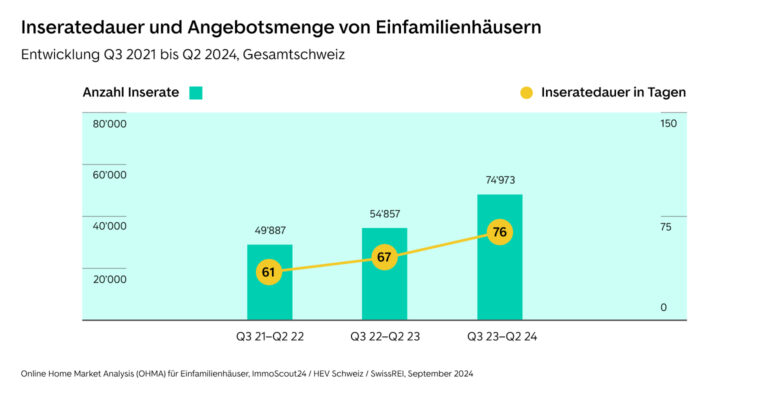
The Online Home Market Analysis is an evaluation of the property supply by Immoscout24 in collaboration with the Homeowners Association and the Swiss Real Estate Institute. The period observed in each year is between the third quarter of the previous year and the second quarter of the following year.

Further increase in the number of listings – albeit at a slower pace

In the 2023/24 period under review, there was a massive increase in the number of single-family homes advertised compared to the same period in the previous year, with a marked rise of 36%. In the previous period, there were again more single-family homes advertised, but to a lesser extent (+ 4%). An upward trend can also be observed in the duration of advertisements throughout Switzerland, with detached houses currently online for an average of 79 days.

Prospective buyers more selective – high-quality sales documents are crucial

For market participants, this means that buyers tend to take a little more time and have become more selective as they have more choice. For sellers, the importance of a well-thought-out marketing strategy with highly professional sales documentation and a contemporary presentation of the property is increasing. Thanks to the continuing very good demand, the price level remains stable, although there are signs of consolidation on the market for detached houses.

S

Online Home Market Analysis

The Online Home Market Analysis is an evaluation of the property supply by Immoscout24 in collaboration with the Homeowners Association and the Swiss Real Estate Institute. The period observed in each year is between the third quarter of the previous year and the second quarter of the following year.

Further increase in the number of listings – albeit at a slower pace

In the 2023/24 period under review, there was a massive increase in the number of single-family homes advertised compared to the same period in the previous year, with a marked rise of 36%. In the previous period, there were again more single-family homes advertised, but to a lesser extent (+ 4%). An upward trend can also be observed in the duration of advertisements throughout Switzerland, with detached houses currently online for an average of 79 days.

Prospective buyers more selective – high-quality sales documents are crucial

For market participants, this means that buyers tend to take a little more time and have become more selective as they have more choice. For sellers, the importance of a well-thought-out marketing strategy with highly professional sales documentation and a contemporary presentation of the property is increasing. Thanks to the continuing very good demand, the price level remains stable, although there are signs of consolidation on the market for detached houses.

S

Optimism despite poor economic forecasts

The Swiss Real Estate Sentiment Index has been measuring the mood among property investors since 2012. Market participants‘ price expectations are the main reason for the highest increase since the index began. Almost all participants expect property prices to rise – especially in the residential segment and, for the first time in a long time, for office space. The price trend for commercial and retail space is still expected to be slightly negative. At the same time, the sector is rather pessimistic about the overall economic situation.

Price boom in all locations

Price expectations for residential property reached a new high of 131 points. Around 94% of respondents expect a slight to strong price increase. Remarkable: For the first time, the price forecasts are also positive for peripheral locations. Expectations are particularly optimistic for the regions of Zurich, Central Switzerland and the Lake Geneva region.

Industry also sees risks

The experts see strict regulation as the biggest challenge – it achieved the highest score ever measured in this year’s survey with 2.5 out of 3 points. In second place is the economic environment in Europe, which is also seen as a risk (2.0 points). Other risks such as payment defaults or interest rate trends play a smaller role.

Conclusion: Despite macroeconomic uncertainties, the Swiss property sector is very optimistic about the coming 12 months. There is a particularly strong belief that prices will continue to rise – even in locations that have previously been less in the spotlight.

Source: Real Estate Move, „Swiss Real Estate Sentiment Index is at its highest level“, 14 October 2025

S

Optimism despite poor economic forecasts

The Swiss Real Estate Sentiment Index has been measuring the mood among property investors since 2012. Market participants‘ price expectations are the main reason for the highest increase since the index began. Almost all participants expect property prices to rise – especially in the residential segment and, for the first time in a long time, for office space. The price trend for commercial and retail space is still expected to be slightly negative. At the same time, the sector is rather pessimistic about the overall economic situation.

Price boom in all locations

Price expectations for residential property reached a new high of 131 points. Around 94% of respondents expect a slight to strong price increase. Remarkable: For the first time, the price forecasts are also positive for peripheral locations. Expectations are particularly optimistic for the regions of Zurich, Central Switzerland and the Lake Geneva region.

Industry also sees risks

The experts see strict regulation as the biggest challenge – it achieved the highest score ever measured in this year’s survey with 2.5 out of 3 points. In second place is the economic environment in Europe, which is also seen as a risk (2.0 points). Other risks such as payment defaults or interest rate trends play a smaller role.

Conclusion: Despite macroeconomic uncertainties, the Swiss property sector is very optimistic about the coming 12 months. There is a particularly strong belief that prices will continue to rise – even in locations that have previously been less in the spotlight.

Source: Real Estate Move, „Swiss Real Estate Sentiment Index is at its highest level“, 14 October 2025

T

What was the imputed rental value?

The imputed rental value was introduced in 1934 during a difficult economic period when the state urgently needed additional revenue. The tax, the only one of its kind in the world, obliged homeowners to pay tax on the notional rental value of their owner-occupied property – on the grounds that they did not have to bear any housing costs compared to tenants.
In return, debt interest as well as maintenance and renovation costs could be deducted from taxes. This system has been the subject of intense debate and repeated attempts at reform for decades – until now.

Winners and losers of the abolition

  • The mainwinners are older owners who have already largely repaid their mortgages and whose properties are in good condition. They will benefit from the abolition of the imputed rental value without having to accept any significant disadvantages in terms of deductions.
  • The losers, on the other hand, are those who have only recently acquired a property in need of renovation – often young families with high mortgage debts. For them, the loss of deductions far outweighs the financial advantage of the abolished imputed rental value.

Effects on the property market

A recent study by the Raiffeisen banks shows that senior citizens keep their properties for a particularly long time and thus contribute significantly to the shortage of single-family homes on the market. The abolition of the imputed rental value reinforces this effect, as holding onto a property becomes even more attractive from a tax perspective. As a result, supply will remain scarce and prices will continue to rise – in a market that is already considered overheated.
There is also another side effect: energy-efficient refurbishments will become less attractive from a tax perspective. Owners are therefore less likely to invest in expensive refurbishments. This could not only run counter to climate targets, but also put a strain on the construction industry with its numerous jobs.

Conclusion

The abolition of the imputed rental value is a historic step – but there can be no question of a clear victory for homeowners. Who benefits and who loses depends heavily on the individual situation. One thing is certain: the debate surrounding home ownership, taxes and property prices will continue to accompany us in the future.

T

What was the imputed rental value?

The imputed rental value was introduced in 1934 during a difficult economic period when the state urgently needed additional revenue. The tax, the only one of its kind in the world, obliged homeowners to pay tax on the notional rental value of their owner-occupied property – on the grounds that they did not have to bear any housing costs compared to tenants.
In return, debt interest as well as maintenance and renovation costs could be deducted from taxes. This system has been the subject of intense debate and repeated attempts at reform for decades – until now.

Winners and losers of the abolition

  • The mainwinners are older owners who have already largely repaid their mortgages and whose properties are in good condition. They will benefit from the abolition of the imputed rental value without having to accept any significant disadvantages in terms of deductions.
  • The losers, on the other hand, are those who have only recently acquired a property in need of renovation – often young families with high mortgage debts. For them, the loss of deductions far outweighs the financial advantage of the abolished imputed rental value.

Effects on the property market

A recent study by the Raiffeisen banks shows that senior citizens keep their properties for a particularly long time and thus contribute significantly to the shortage of single-family homes on the market. The abolition of the imputed rental value reinforces this effect, as holding onto a property becomes even more attractive from a tax perspective. As a result, supply will remain scarce and prices will continue to rise – in a market that is already considered overheated.
There is also another side effect: energy-efficient refurbishments will become less attractive from a tax perspective. Owners are therefore less likely to invest in expensive refurbishments. This could not only run counter to climate targets, but also put a strain on the construction industry with its numerous jobs.

Conclusion

The abolition of the imputed rental value is a historic step – but there can be no question of a clear victory for homeowners. Who benefits and who loses depends heavily on the individual situation. One thing is certain: the debate surrounding home ownership, taxes and property prices will continue to accompany us in the future.

D

SARON mortgages: margins eat up SNB cut

SARON mortgages, so-called money market mortgages, are based on the central banks‘ key interest rate. The effective interest rate is calculated from the base rate + the banks‘ margin. Despite the base rate of 0%, the best offers for SARON mortgages are currently around 0.75% (source: Hypotheke.ch), which equates to an equally high margin. Twelve months ago, this margin was still at 0.45% This clearly shows that banks have widened their margins and that the SNB’s monetary easing is not being felt by customers.

Fixed-rate mortgages: slightly weaker development

The trend in fixed-rate mortgages is somewhat less clear. Here too, margins have risen. At the end of June, the most favourable offers for a ten-year fixed-rate mortgage were still at 1.3 percent. It is now 1.38 per cent – an increase of 0.08 percentage points. (Source cash.ch)

Actually, the opposite would have been expected: The yield on ten-year federal bonds, which is decisive for fixed-rate mortgages, has fallen from 0.41 to 0.24 per cent in the same period. Swap rates, the second important reference value, have also fallen and are around 0.1 percent below the level of 21 June 2025, when the SNB last lowered the key interest rate to 0.0 percent.

Banks protect margins – less competition exacerbates the situation

Mortgage conditions not only reflect market developments, but also the banks‘ earnings strategy. Due to the SNB’s zero interest rate, short-term interest income is collapsing, which is why the institutions are trying to secure their profit margins with higher premiums on mortgages. The fact that this is succeeding is also due to the market situation. With the disappearance of Credit Suisse, there is no longer a major provider, and many pension funds and insurance companies have largely withdrawn from the mortgage business due to a lack of distribution channels. The reduced competition allows banks to easily pass on higher margins. This effect is exacerbated by regulatory pressure under Basel III, which, among other things, imposes higher capital requirements and thus also contributes to higher prices.

Outlook: No easing in sight

For borrowers, this means that hopes of noticeably lower mortgage rates have not yet been realised – neither for SARON nor for fixed-rate mortgages. Margins are likely to remain high in the short term as long as competition in the market is limited. In the longer term, the development of fixed-rate mortgages depends heavily on the international capital markets and inflation expectations, which currently remain volatile.

D

SARON mortgages: margins eat up SNB cut

SARON mortgages, so-called money market mortgages, are based on the central banks‘ key interest rate. The effective interest rate is calculated from the base rate + the banks‘ margin. Despite the base rate of 0%, the best offers for SARON mortgages are currently around 0.75% (source: Hypotheke.ch), which equates to an equally high margin. Twelve months ago, this margin was still at 0.45% This clearly shows that banks have widened their margins and that the SNB’s monetary easing is not being felt by customers.

Fixed-rate mortgages: slightly weaker development

The trend in fixed-rate mortgages is somewhat less clear. Here too, margins have risen. At the end of June, the most favourable offers for a ten-year fixed-rate mortgage were still at 1.3 percent. It is now 1.38 per cent – an increase of 0.08 percentage points. (Source cash.ch)

Actually, the opposite would have been expected: The yield on ten-year federal bonds, which is decisive for fixed-rate mortgages, has fallen from 0.41 to 0.24 per cent in the same period. Swap rates, the second important reference value, have also fallen and are around 0.1 percent below the level of 21 June 2025, when the SNB last lowered the key interest rate to 0.0 percent.

Banks protect margins – less competition exacerbates the situation

Mortgage conditions not only reflect market developments, but also the banks‘ earnings strategy. Due to the SNB’s zero interest rate, short-term interest income is collapsing, which is why the institutions are trying to secure their profit margins with higher premiums on mortgages. The fact that this is succeeding is also due to the market situation. With the disappearance of Credit Suisse, there is no longer a major provider, and many pension funds and insurance companies have largely withdrawn from the mortgage business due to a lack of distribution channels. The reduced competition allows banks to easily pass on higher margins. This effect is exacerbated by regulatory pressure under Basel III, which, among other things, imposes higher capital requirements and thus also contributes to higher prices.

Outlook: No easing in sight

For borrowers, this means that hopes of noticeably lower mortgage rates have not yet been realised – neither for SARON nor for fixed-rate mortgages. Margins are likely to remain high in the short term as long as competition in the market is limited. In the longer term, the development of fixed-rate mortgages depends heavily on the international capital markets and inflation expectations, which currently remain volatile.

U

Calls for a stronger rate cut

US President Donald Trump had previously demanded a more substantial cut. Trump-aligned economist Stephan Miran also advocated for a bolder step within the monetary policy committee, but was unable to prevail. The majority of the twelve voting members supported the moderate reduction of 0.25 percentage points.

Labor market as key factor

The decision was driven less by political pressure than by developments in the labor market, which has been losing momentum for some time. With the rate cut, the FED is seeking to strike a balance: on the one hand, supporting the economy and especially employment; on the other, keeping the still-elevated inflation under control.

Implications for Switzerland

Direct effects on the Swiss interest rate and property market are not expected from this decision. Nevertheless, the policy shift of the world’s most influential central bank sends a strong signal. The FED’s move reinforces the impression that a global phase of falling interest rates has begun. For Switzerland, this suggests that mortgages are likely to remain attractive – a factor that could continue to support price dynamics in the real estate market.

U

Calls for a stronger rate cut

US President Donald Trump had previously demanded a more substantial cut. Trump-aligned economist Stephan Miran also advocated for a bolder step within the monetary policy committee, but was unable to prevail. The majority of the twelve voting members supported the moderate reduction of 0.25 percentage points.

Labor market as key factor

The decision was driven less by political pressure than by developments in the labor market, which has been losing momentum for some time. With the rate cut, the FED is seeking to strike a balance: on the one hand, supporting the economy and especially employment; on the other, keeping the still-elevated inflation under control.

Implications for Switzerland

Direct effects on the Swiss interest rate and property market are not expected from this decision. Nevertheless, the policy shift of the world’s most influential central bank sends a strong signal. The FED’s move reinforces the impression that a global phase of falling interest rates has begun. For Switzerland, this suggests that mortgages are likely to remain attractive – a factor that could continue to support price dynamics in the real estate market.

T

Commercial spaces

The weakening export economy and worsening location conditions in relation to the EU are reducing the demand for commercial and industrial space. However, as many properties are owned by the companies concerned, the impact on rents remains moderate.

Residential property

Private property is also suffering from the crisis. Weaker employment growth is reducing immigration and purchasing power, so price increases are slightly more moderate. Overall, the effect remains limited as long as the pharmaceutical and chemical industries manage to maintain their profitability at a good level.

Interest rates are expected to fall further

A slight fall in interest rates will have a stabilising effect and reduce negative influences. At the same time, national real estate orientation is proving to be a double-edged sword: it protects against the direct effects of tariffs, but makes the Swiss economy more vulnerable if it suffers more than the EU. Moreover, banks are not passing on interest rate cuts to their customers in the same way.

Inflation and construction prices

The impact on inflation and construction prices is slight, as cost increases are offset by oversupply and the economic slowdown. Regionally, it is mainly industrial and agricultural communities that are affected, while financial centres and tourist regions are largely spared.

In short, only a slight correction in the real estate market

Overall, according to Wüest Partner, the Swiss real estate market is only reacting moderately to the rates. Market mechanisms and the slight fall in interest rates are having a stabilising effect, so the impact remains moderate overall.

T

Commercial spaces

The weakening export economy and worsening location conditions in relation to the EU are reducing the demand for commercial and industrial space. However, as many properties are owned by the companies concerned, the impact on rents remains moderate.

Residential property

Private property is also suffering from the crisis. Weaker employment growth is reducing immigration and purchasing power, so price increases are slightly more moderate. Overall, the effect remains limited as long as the pharmaceutical and chemical industries manage to maintain their profitability at a good level.

Interest rates are expected to fall further

A slight fall in interest rates will have a stabilising effect and reduce negative influences. At the same time, national real estate orientation is proving to be a double-edged sword: it protects against the direct effects of tariffs, but makes the Swiss economy more vulnerable if it suffers more than the EU. Moreover, banks are not passing on interest rate cuts to their customers in the same way.

Inflation and construction prices

The impact on inflation and construction prices is slight, as cost increases are offset by oversupply and the economic slowdown. Regionally, it is mainly industrial and agricultural communities that are affected, while financial centres and tourist regions are largely spared.

In short, only a slight correction in the real estate market

Overall, according to Wüest Partner, the Swiss real estate market is only reacting moderately to the rates. Market mechanisms and the slight fall in interest rates are having a stabilising effect, so the impact remains moderate overall.

Processing...

Sign In

Thank you.

Your viewing request has been successfully submitted. We will be in touch soon to confirm the details.