Find out what real clients
have to say

Over 44,000 People in Switzerland Have Used the
Swiss Property Owners Association to Achieve Better
Results in Buying or Selling Their Home

Find out what real clients have to say

Over 44,000 People in Switzerland Have Used the Swiss Property Owners Association to Achieve Better Results in Buying or Selling Their Home

Geopolitical shock hits the global economy

The effects of the Iran war are massive: the blockade of key trade routes such as the Strait of Hormuz is driving up oil and gas prices and increasing inflation risks worldwide. At the same time, economic momentum in Europe and other industrialised nations is suffering significantly from the increased costs.

This combination of inflation and weaker growth – often referred to as „stagflation“ – has direct consequences for interest rates, investments and therefore also for property markets.

Swiss property as a safe haven

Against this backdrop, Swiss property is becoming increasingly attractive. According to a recently published UBS analysis, international investors see it as a stable hedge against geopolitical risks.

A key driver is the strong Swiss franc, which also appreciates in times of crisis and safeguards investments. Luxury and holiday properties in top destinations such as St. Moritz and Gstaad, where international buyers continue to play a key role, remain particularly popular.

Mortgages: stability despite global pressure

Despite global inflationary pressure as a result of the war in Iran, interest rates for money market mortgages in Switzerland are expected to remain stable. Long-term fixed-rate mortgages, on the other hand, are showing a slight upward trend, as rising energy prices and inflation are also having an impact on the capital markets in this country.

For homeowners, this means little change in the short term, but rising financing costs in the long term.

Property investments benefit

Listed property investments are also proving robust. While many stock markets are suffering from the consequences of the war in Iran, property values are showing comparatively stable development.

However, this stability comes at a price: valuations are high and experts are warning that rising interest rates or an escalation of the conflict could lead to corrections.

Conclusion: Winners of the crisis – with risks

The Iran war is shifting capital flows worldwide – away from insecure regions and towards stable markets such as Switzerland. Property is benefiting from this in particular.

However, the situation remains fragile: if the conflict escalates further, rising interest rates and an economic slowdown could also put the previously robust Swiss property market under greater pressure.

The Swiss Property Owners Association (Grundeigentümerverband Schweiz) has been recognized in the March edition of the Swiss business magazine BILANZ as one of the “Top Real Estate Experts in Switzerland 2026” in the following four categories:

  • Real Estate Valuation
  • Buying and Selling (Real Estate Brokerage)
  • Real Estate Financing
  • Luxury Real Estate Expertise

We see these distinctions as confirmation that our guiding principle, “Investing in real estate intelligently,” is the right path forward. Only a holistic advisory approach can meet the demands of an increasingly complex market environment.

With more than 60 employees, the Swiss Property Owners Association will continue to dedicate its expertise and commitment to supporting our more than 70,000 members with comprehensive advice and practical assistance.

Read the official article in BILANZ here.

Ageing Switzerland

Demographic change is in full swing in many regions of the world and in Europe in particular. Switzerland is no exception. While the birth rate has reached a record low of 1.29 children per woman in 2024, life expectancy is rising continuously and, according to the Federal Statistical Office, will be just under 86 years for women (as of 2024). As a result, the number of people in employment is steadily decreasing, while there are more retirees and senior citizens. The number of families is also falling accordingly, especially those with more than one child.

Effects on the property sector

According to Swissinfo.ch, the cantons of Ticino, Bern, Neuchâtel, Jura, Appenzell Ausserrhoden, Nidwalden, Obwalden, Graubünden, Glarus and Schaffhausen are already showing signs of stagnating demand in sales, which can be seen, for example, in the increased duration of advertisements. Large family flats and detached houses are particularly affected, as older people are no longer asking for these sizes, or only to a lesser extent.
The number of transactions is also falling, as people over 65 are making fewer changes to their current living situation.

Conclusion: More affordable housing for families soon?

The cantons listed include many that have a high proportion of rural and in some cases structurally weak areas. These cantons are the first to feel the effects of demographic change. However, sooner or later the effects will affect the whole of Switzerland. In terms of demand, the developments are likely to mean the following: Flats up to 4.5 rooms and smaller are likely to be in greater demand, while larger flats and single-family homes will be available in higher numbers, which will be reflected in lower prices.

A

Opportunities of AI – more efficiency and speed

AI automates and therefore speeds up many processes. For example, property management companies use chatbots to answer tenants‘ questions, agents automate the creation of brochures and advertisements, and draughtsmen and architects use AI to optimise their floor plans. The increase in speed is correspondingly high for standardised processes, meaning that a significantly larger amount of data can be processed in the time available.

Risk: Quality

With the much-praised automation of processes, their quality deteriorates. Because what many people don’t realise: AI cannot produce new content, but copies data and passes it on in different versions. This results, for example, in very generalised advertising texts that inadequately describe the strengths of a property. In the case of chatbots used by public authorities, it is also important to scrutinise the extent to which they are a benefit or a nuisance from the customer’s point of view.

Conclusion: Well thought-out use is crucial

However, the property industry remains first and foremost a people’s business. Trust and proximity still influence purchasing decisions and the choice of service provider to a very high degree. AI has not mastered these crucial skills.
The well thought-out use of AI is crucial for companies. While highly automated work steps that are effectively the same every time they are repeated, such as entering data into a mask, result in a valuable efficiency gain, it is important to scrutinise whether the quality of service is not being compromised too much, especially in creative processes. The take-home message is: AI is not an omniscient machine, but a useful tool that helps in certain areas and less so in others.

A

Opportunities of AI – more efficiency and speed

AI automates and therefore speeds up many processes. For example, property management companies use chatbots to answer tenants‘ questions, agents automate the creation of brochures and advertisements, and draughtsmen and architects use AI to optimise their floor plans. The increase in speed is correspondingly high for standardised processes, meaning that a significantly larger amount of data can be processed in the time available.

Risk: Quality

With the much-praised automation of processes, their quality deteriorates. Because what many people don’t realise: AI cannot produce new content, but copies data and passes it on in different versions. This results, for example, in very generalised advertising texts that inadequately describe the strengths of a property. In the case of chatbots used by public authorities, it is also important to scrutinise the extent to which they are a benefit or a nuisance from the customer’s point of view.

Conclusion: Well thought-out use is crucial

However, the property industry remains first and foremost a people’s business. Trust and proximity still influence purchasing decisions and the choice of service provider to a very high degree. AI has not mastered these crucial skills.
The well thought-out use of AI is crucial for companies. While highly automated work steps that are effectively the same every time they are repeated, such as entering data into a mask, result in a valuable efficiency gain, it is important to scrutinise whether the quality of service is not being compromised too much, especially in creative processes. The take-home message is: AI is not an omniscient machine, but a useful tool that helps in certain areas and less so in others.

T

Further general price increase

Living space in Switzerland remains popular and sought-after. This will not change even if the last digit in the calendar changes to a 6. Demand continues to rise, partly thanks to population growth and attractive conditions on the mortgage market (no significant rise in the base rate expected). Combined with construction activity that is still too low, this will lead to a further increase in transaction prices.

New builds and refurbished properties

The price increase particularly affects refurbished properties in good condition. The abolition of the imputed rental value (implementation from 2028, effect already noticeable on the market) will remove the additional tax burden. If refurbishments are not particularly necessary, this will generally make such properties more affordable and prices will continue to rise accordingly.

Alternative old building?

However, if you also keep an eye out for older properties on the market, there is certainly hope that you will still be able to acquire them at reasonable prices. As it will no longer be possible to deduct renovations from taxes in the future, many buyers will think carefully about whether they really want to invest. In the case of older properties, the potential savings often far outweigh the loss of notional income. In addition, mortgage interest is only deductible to a limited extent.
This opens the door for buyers who are prepared to compromise on standard and condition for a certain period of time, or for do-it-yourselfers who can make the refurbishment cheaper than others. They could benefit from stagnating or even falling prices.

Conclusion

The Swiss property market remains competitive and the price carousel continues to turn upwards. Old buildings could offer an exciting alternative for a limited group of potential buyers

T

Further general price increase

Living space in Switzerland remains popular and sought-after. This will not change even if the last digit in the calendar changes to a 6. Demand continues to rise, partly thanks to population growth and attractive conditions on the mortgage market (no significant rise in the base rate expected). Combined with construction activity that is still too low, this will lead to a further increase in transaction prices.

New builds and refurbished properties

The price increase particularly affects refurbished properties in good condition. The abolition of the imputed rental value (implementation from 2028, effect already noticeable on the market) will remove the additional tax burden. If refurbishments are not particularly necessary, this will generally make such properties more affordable and prices will continue to rise accordingly.

Alternative old building?

However, if you also keep an eye out for older properties on the market, there is certainly hope that you will still be able to acquire them at reasonable prices. As it will no longer be possible to deduct renovations from taxes in the future, many buyers will think carefully about whether they really want to invest. In the case of older properties, the potential savings often far outweigh the loss of notional income. In addition, mortgage interest is only deductible to a limited extent.
This opens the door for buyers who are prepared to compromise on standard and condition for a certain period of time, or for do-it-yourselfers who can make the refurbishment cheaper than others. They could benefit from stagnating or even falling prices.

Conclusion

The Swiss property market remains competitive and the price carousel continues to turn upwards. Old buildings could offer an exciting alternative for a limited group of potential buyers

S

Online Home Market Analysis

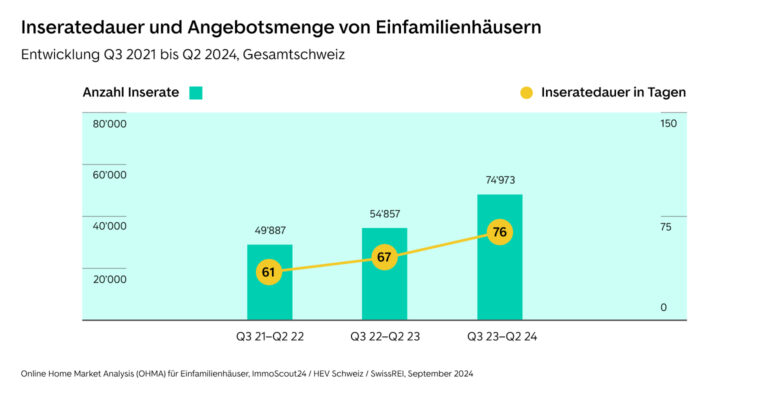
The Online Home Market Analysis is an evaluation of the property supply by Immoscout24 in collaboration with the Homeowners Association and the Swiss Real Estate Institute. The period observed in each year is between the third quarter of the previous year and the second quarter of the following year.

Further increase in the number of listings – albeit at a slower pace

In the 2023/24 period under review, there was a massive increase in the number of single-family homes advertised compared to the same period in the previous year, with a marked rise of 36%. In the previous period, there were again more single-family homes advertised, but to a lesser extent (+ 4%). An upward trend can also be observed in the duration of advertisements throughout Switzerland, with detached houses currently online for an average of 79 days.

Prospective buyers more selective – high-quality sales documents are crucial

For market participants, this means that buyers tend to take a little more time and have become more selective as they have more choice. For sellers, the importance of a well-thought-out marketing strategy with highly professional sales documentation and a contemporary presentation of the property is increasing. Thanks to the continuing very good demand, the price level remains stable, although there are signs of consolidation on the market for detached houses.

S

Online Home Market Analysis

The Online Home Market Analysis is an evaluation of the property supply by Immoscout24 in collaboration with the Homeowners Association and the Swiss Real Estate Institute. The period observed in each year is between the third quarter of the previous year and the second quarter of the following year.

Further increase in the number of listings – albeit at a slower pace

In the 2023/24 period under review, there was a massive increase in the number of single-family homes advertised compared to the same period in the previous year, with a marked rise of 36%. In the previous period, there were again more single-family homes advertised, but to a lesser extent (+ 4%). An upward trend can also be observed in the duration of advertisements throughout Switzerland, with detached houses currently online for an average of 79 days.

Prospective buyers more selective – high-quality sales documents are crucial

For market participants, this means that buyers tend to take a little more time and have become more selective as they have more choice. For sellers, the importance of a well-thought-out marketing strategy with highly professional sales documentation and a contemporary presentation of the property is increasing. Thanks to the continuing very good demand, the price level remains stable, although there are signs of consolidation on the market for detached houses.

S

Optimism despite poor economic forecasts

The Swiss Real Estate Sentiment Index has been measuring the mood among property investors since 2012. Market participants‘ price expectations are the main reason for the highest increase since the index began. Almost all participants expect property prices to rise – especially in the residential segment and, for the first time in a long time, for office space. The price trend for commercial and retail space is still expected to be slightly negative. At the same time, the sector is rather pessimistic about the overall economic situation.

Price boom in all locations

Price expectations for residential property reached a new high of 131 points. Around 94% of respondents expect a slight to strong price increase. Remarkable: For the first time, the price forecasts are also positive for peripheral locations. Expectations are particularly optimistic for the regions of Zurich, Central Switzerland and the Lake Geneva region.

Industry also sees risks

The experts see strict regulation as the biggest challenge – it achieved the highest score ever measured in this year’s survey with 2.5 out of 3 points. In second place is the economic environment in Europe, which is also seen as a risk (2.0 points). Other risks such as payment defaults or interest rate trends play a smaller role.

Conclusion: Despite macroeconomic uncertainties, the Swiss property sector is very optimistic about the coming 12 months. There is a particularly strong belief that prices will continue to rise – even in locations that have previously been less in the spotlight.

Source: Real Estate Move, „Swiss Real Estate Sentiment Index is at its highest level“, 14 October 2025

S

Optimism despite poor economic forecasts

The Swiss Real Estate Sentiment Index has been measuring the mood among property investors since 2012. Market participants‘ price expectations are the main reason for the highest increase since the index began. Almost all participants expect property prices to rise – especially in the residential segment and, for the first time in a long time, for office space. The price trend for commercial and retail space is still expected to be slightly negative. At the same time, the sector is rather pessimistic about the overall economic situation.

Price boom in all locations

Price expectations for residential property reached a new high of 131 points. Around 94% of respondents expect a slight to strong price increase. Remarkable: For the first time, the price forecasts are also positive for peripheral locations. Expectations are particularly optimistic for the regions of Zurich, Central Switzerland and the Lake Geneva region.

Industry also sees risks

The experts see strict regulation as the biggest challenge – it achieved the highest score ever measured in this year’s survey with 2.5 out of 3 points. In second place is the economic environment in Europe, which is also seen as a risk (2.0 points). Other risks such as payment defaults or interest rate trends play a smaller role.

Conclusion: Despite macroeconomic uncertainties, the Swiss property sector is very optimistic about the coming 12 months. There is a particularly strong belief that prices will continue to rise – even in locations that have previously been less in the spotlight.

Source: Real Estate Move, „Swiss Real Estate Sentiment Index is at its highest level“, 14 October 2025

T

What was the imputed rental value?

The imputed rental value was introduced in 1934 during a difficult economic period when the state urgently needed additional revenue. The tax, the only one of its kind in the world, obliged homeowners to pay tax on the notional rental value of their owner-occupied property – on the grounds that they did not have to bear any housing costs compared to tenants.
In return, debt interest as well as maintenance and renovation costs could be deducted from taxes. This system has been the subject of intense debate and repeated attempts at reform for decades – until now.

Winners and losers of the abolition

  • The mainwinners are older owners who have already largely repaid their mortgages and whose properties are in good condition. They will benefit from the abolition of the imputed rental value without having to accept any significant disadvantages in terms of deductions.
  • The losers, on the other hand, are those who have only recently acquired a property in need of renovation – often young families with high mortgage debts. For them, the loss of deductions far outweighs the financial advantage of the abolished imputed rental value.

Effects on the property market

A recent study by the Raiffeisen banks shows that senior citizens keep their properties for a particularly long time and thus contribute significantly to the shortage of single-family homes on the market. The abolition of the imputed rental value reinforces this effect, as holding onto a property becomes even more attractive from a tax perspective. As a result, supply will remain scarce and prices will continue to rise – in a market that is already considered overheated.
There is also another side effect: energy-efficient refurbishments will become less attractive from a tax perspective. Owners are therefore less likely to invest in expensive refurbishments. This could not only run counter to climate targets, but also put a strain on the construction industry with its numerous jobs.

Conclusion

The abolition of the imputed rental value is a historic step – but there can be no question of a clear victory for homeowners. Who benefits and who loses depends heavily on the individual situation. One thing is certain: the debate surrounding home ownership, taxes and property prices will continue to accompany us in the future.

T

What was the imputed rental value?

The imputed rental value was introduced in 1934 during a difficult economic period when the state urgently needed additional revenue. The tax, the only one of its kind in the world, obliged homeowners to pay tax on the notional rental value of their owner-occupied property – on the grounds that they did not have to bear any housing costs compared to tenants.
In return, debt interest as well as maintenance and renovation costs could be deducted from taxes. This system has been the subject of intense debate and repeated attempts at reform for decades – until now.

Winners and losers of the abolition

  • The mainwinners are older owners who have already largely repaid their mortgages and whose properties are in good condition. They will benefit from the abolition of the imputed rental value without having to accept any significant disadvantages in terms of deductions.
  • The losers, on the other hand, are those who have only recently acquired a property in need of renovation – often young families with high mortgage debts. For them, the loss of deductions far outweighs the financial advantage of the abolished imputed rental value.

Effects on the property market

A recent study by the Raiffeisen banks shows that senior citizens keep their properties for a particularly long time and thus contribute significantly to the shortage of single-family homes on the market. The abolition of the imputed rental value reinforces this effect, as holding onto a property becomes even more attractive from a tax perspective. As a result, supply will remain scarce and prices will continue to rise – in a market that is already considered overheated.
There is also another side effect: energy-efficient refurbishments will become less attractive from a tax perspective. Owners are therefore less likely to invest in expensive refurbishments. This could not only run counter to climate targets, but also put a strain on the construction industry with its numerous jobs.

Conclusion

The abolition of the imputed rental value is a historic step – but there can be no question of a clear victory for homeowners. Who benefits and who loses depends heavily on the individual situation. One thing is certain: the debate surrounding home ownership, taxes and property prices will continue to accompany us in the future.

D

SARON mortgages: margins eat up SNB cut

SARON mortgages, so-called money market mortgages, are based on the central banks‘ key interest rate. The effective interest rate is calculated from the base rate + the banks‘ margin. Despite the base rate of 0%, the best offers for SARON mortgages are currently around 0.75% (source: Hypotheke.ch), which equates to an equally high margin. Twelve months ago, this margin was still at 0.45% This clearly shows that banks have widened their margins and that the SNB’s monetary easing is not being felt by customers.

Fixed-rate mortgages: slightly weaker development

The trend in fixed-rate mortgages is somewhat less clear. Here too, margins have risen. At the end of June, the most favourable offers for a ten-year fixed-rate mortgage were still at 1.3 percent. It is now 1.38 per cent – an increase of 0.08 percentage points. (Source cash.ch)

Actually, the opposite would have been expected: The yield on ten-year federal bonds, which is decisive for fixed-rate mortgages, has fallen from 0.41 to 0.24 per cent in the same period. Swap rates, the second important reference value, have also fallen and are around 0.1 percent below the level of 21 June 2025, when the SNB last lowered the key interest rate to 0.0 percent.

Banks protect margins – less competition exacerbates the situation

Mortgage conditions not only reflect market developments, but also the banks‘ earnings strategy. Due to the SNB’s zero interest rate, short-term interest income is collapsing, which is why the institutions are trying to secure their profit margins with higher premiums on mortgages. The fact that this is succeeding is also due to the market situation. With the disappearance of Credit Suisse, there is no longer a major provider, and many pension funds and insurance companies have largely withdrawn from the mortgage business due to a lack of distribution channels. The reduced competition allows banks to easily pass on higher margins. This effect is exacerbated by regulatory pressure under Basel III, which, among other things, imposes higher capital requirements and thus also contributes to higher prices.

Outlook: No easing in sight

For borrowers, this means that hopes of noticeably lower mortgage rates have not yet been realised – neither for SARON nor for fixed-rate mortgages. Margins are likely to remain high in the short term as long as competition in the market is limited. In the longer term, the development of fixed-rate mortgages depends heavily on the international capital markets and inflation expectations, which currently remain volatile.

D

SARON mortgages: margins eat up SNB cut

SARON mortgages, so-called money market mortgages, are based on the central banks‘ key interest rate. The effective interest rate is calculated from the base rate + the banks‘ margin. Despite the base rate of 0%, the best offers for SARON mortgages are currently around 0.75% (source: Hypotheke.ch), which equates to an equally high margin. Twelve months ago, this margin was still at 0.45% This clearly shows that banks have widened their margins and that the SNB’s monetary easing is not being felt by customers.

Fixed-rate mortgages: slightly weaker development

The trend in fixed-rate mortgages is somewhat less clear. Here too, margins have risen. At the end of June, the most favourable offers for a ten-year fixed-rate mortgage were still at 1.3 percent. It is now 1.38 per cent – an increase of 0.08 percentage points. (Source cash.ch)

Actually, the opposite would have been expected: The yield on ten-year federal bonds, which is decisive for fixed-rate mortgages, has fallen from 0.41 to 0.24 per cent in the same period. Swap rates, the second important reference value, have also fallen and are around 0.1 percent below the level of 21 June 2025, when the SNB last lowered the key interest rate to 0.0 percent.

Banks protect margins – less competition exacerbates the situation

Mortgage conditions not only reflect market developments, but also the banks‘ earnings strategy. Due to the SNB’s zero interest rate, short-term interest income is collapsing, which is why the institutions are trying to secure their profit margins with higher premiums on mortgages. The fact that this is succeeding is also due to the market situation. With the disappearance of Credit Suisse, there is no longer a major provider, and many pension funds and insurance companies have largely withdrawn from the mortgage business due to a lack of distribution channels. The reduced competition allows banks to easily pass on higher margins. This effect is exacerbated by regulatory pressure under Basel III, which, among other things, imposes higher capital requirements and thus also contributes to higher prices.

Outlook: No easing in sight

For borrowers, this means that hopes of noticeably lower mortgage rates have not yet been realised – neither for SARON nor for fixed-rate mortgages. Margins are likely to remain high in the short term as long as competition in the market is limited. In the longer term, the development of fixed-rate mortgages depends heavily on the international capital markets and inflation expectations, which currently remain volatile.

U

Calls for a stronger rate cut

US President Donald Trump had previously demanded a more substantial cut. Trump-aligned economist Stephan Miran also advocated for a bolder step within the monetary policy committee, but was unable to prevail. The majority of the twelve voting members supported the moderate reduction of 0.25 percentage points.

Labor market as key factor

The decision was driven less by political pressure than by developments in the labor market, which has been losing momentum for some time. With the rate cut, the FED is seeking to strike a balance: on the one hand, supporting the economy and especially employment; on the other, keeping the still-elevated inflation under control.

Implications for Switzerland

Direct effects on the Swiss interest rate and property market are not expected from this decision. Nevertheless, the policy shift of the world’s most influential central bank sends a strong signal. The FED’s move reinforces the impression that a global phase of falling interest rates has begun. For Switzerland, this suggests that mortgages are likely to remain attractive – a factor that could continue to support price dynamics in the real estate market.

U

Calls for a stronger rate cut

US President Donald Trump had previously demanded a more substantial cut. Trump-aligned economist Stephan Miran also advocated for a bolder step within the monetary policy committee, but was unable to prevail. The majority of the twelve voting members supported the moderate reduction of 0.25 percentage points.

Labor market as key factor

The decision was driven less by political pressure than by developments in the labor market, which has been losing momentum for some time. With the rate cut, the FED is seeking to strike a balance: on the one hand, supporting the economy and especially employment; on the other, keeping the still-elevated inflation under control.

Implications for Switzerland

Direct effects on the Swiss interest rate and property market are not expected from this decision. Nevertheless, the policy shift of the world’s most influential central bank sends a strong signal. The FED’s move reinforces the impression that a global phase of falling interest rates has begun. For Switzerland, this suggests that mortgages are likely to remain attractive – a factor that could continue to support price dynamics in the real estate market.

T

Commercial spaces

The weakening export economy and worsening location conditions in relation to the EU are reducing the demand for commercial and industrial space. However, as many properties are owned by the companies concerned, the impact on rents remains moderate.

Residential property

Private property is also suffering from the crisis. Weaker employment growth is reducing immigration and purchasing power, so price increases are slightly more moderate. Overall, the effect remains limited as long as the pharmaceutical and chemical industries manage to maintain their profitability at a good level.

Interest rates are expected to fall further

A slight fall in interest rates will have a stabilising effect and reduce negative influences. At the same time, national real estate orientation is proving to be a double-edged sword: it protects against the direct effects of tariffs, but makes the Swiss economy more vulnerable if it suffers more than the EU. Moreover, banks are not passing on interest rate cuts to their customers in the same way.

Inflation and construction prices

The impact on inflation and construction prices is slight, as cost increases are offset by oversupply and the economic slowdown. Regionally, it is mainly industrial and agricultural communities that are affected, while financial centres and tourist regions are largely spared.

In short, only a slight correction in the real estate market

Overall, according to Wüest Partner, the Swiss real estate market is only reacting moderately to the rates. Market mechanisms and the slight fall in interest rates are having a stabilising effect, so the impact remains moderate overall.

T

Commercial spaces

The weakening export economy and worsening location conditions in relation to the EU are reducing the demand for commercial and industrial space. However, as many properties are owned by the companies concerned, the impact on rents remains moderate.

Residential property

Private property is also suffering from the crisis. Weaker employment growth is reducing immigration and purchasing power, so price increases are slightly more moderate. Overall, the effect remains limited as long as the pharmaceutical and chemical industries manage to maintain their profitability at a good level.

Interest rates are expected to fall further

A slight fall in interest rates will have a stabilising effect and reduce negative influences. At the same time, national real estate orientation is proving to be a double-edged sword: it protects against the direct effects of tariffs, but makes the Swiss economy more vulnerable if it suffers more than the EU. Moreover, banks are not passing on interest rate cuts to their customers in the same way.

Inflation and construction prices

The impact on inflation and construction prices is slight, as cost increases are offset by oversupply and the economic slowdown. Regionally, it is mainly industrial and agricultural communities that are affected, while financial centres and tourist regions are largely spared.

In short, only a slight correction in the real estate market

Overall, according to Wüest Partner, the Swiss real estate market is only reacting moderately to the rates. Market mechanisms and the slight fall in interest rates are having a stabilising effect, so the impact remains moderate overall.

L

What is often forgotten: Many real estate purchases made by ‚persons from abroad‘ are not subject to the Lex Koller. This is because not only nationality is decisive, but also residency status. In practice, someone who has a residence permit is often not considered a ‚person abroad‘ within the meaning of the Lex Koller – and therefore does not need permission

.

What does the Lex Koller regulate and to whom does it actually apply?

In principle, the Lex Koller requires foreign nationals to apply for a permit before acquiring land or property in Switzerland. At first sight, this seems restrictive, but in reality the law only applies to a small proportion of cases. The reason is that many buyers are not considered foreign citizens under the law.

They are not considered foreign nationals within the meaning of the Lex Koller

  • all persons in possession of a residence permit C and domiciled in Switzerland
  • nationals of EU/EFTA countries who reside in Switzerland and hold at least a B residence permit

In practice, this means that, for example, German nationals with a B permit or US citizens with a C permit living in Switzerland can buy a house without any problems – and without having to obtain a permit. This puts them on an equal footing with Swiss citizens as far as real estate transactions are concerned.

The following diagram shows the scope of application of the Lex Koller according to use and type of property:

Exceptions to the authorisation requirement – clearly regulated

If it is indeed persons from abroad within the meaning of the Lex Koller, the law nevertheless provides for several exceptions for which no authorisation is required. The main exceptions are as follows:

  1. Third-country national s holding a B residence permit and domiciled in Switzerland may purchase a property as their main residence.
  2. Cross-border commuters may purchase a second home in the border area of their place of work .
  3. Permanent establishments: commercial properties used for operational purposes can be purchased regardless of the residence status or origin of the owners.
  4. Holiday flats: in recognised tourist regions, up to 1,500 units may be sold to foreign residents each year throughout Switzerland. Quotas are allocated by the cantons and municipalities may also set their own restrictions or refusals.

Restrictions on exceptions

Anyone requesting an exception is subject to specific restrictions on the use and nature of the property.

Surface :

  • main residence (third-country nationals): max. 3,000 m².
  • holiday accommodation: max. 2,000 m².
  • Cross-border commuters: max .1,000 m².

Living space :

  • Holiday flats: max . 200 m².
  • For the other categories, there is no legal limit on living space.

Other features:

  • Renting is not permitted in all exceptional cases.
  • For building land: constructionmust begin within one year.

Principle: if a permit is needed, it is usually a problem.

If permission is nevertheless required as part of a transaction, special care must be taken. In advisory practice, the principle is that an acquisition subject to authorisation is a special case and should always be examined with a critical eye. In such cases, it is advisable to involve the competent cantonal authorities at an early stage and, if necessary, to ask for prior clarification (request for a statement of facts)

.

Procedure and powers

The cantonal authorities are responsible for verifying the need for an authorisation and for granting it . In case of uncertainty , a request for a ruling can be submitted to obtain clarification on the applicability of the Lex Koller

.

Conclusion – Understanding and applying the Lex Koller

At first sight, the Lex Koller appears to be a comprehensive and restrictive law. In practice ,however, itisnot appliedin many cases, as a large percentage of buyers are not considered foreigners within the meaning of the law. The decisivefactoris notnationality, but residency status.

Only when a permit is required does more care need to be taken. In these cases, a thorough examination should be carried out, possibly with the participation of the cantonal authorities.

The rule for real estate professionals is therefore: do not be discouraged – provide differentiated and legally secure advice.

L

What is often forgotten: Many real estate purchases made by ‚persons from abroad‘ are not subject to the Lex Koller. This is because not only nationality is decisive, but also residency status. In practice, someone who has a residence permit is often not considered a ‚person abroad‘ within the meaning of the Lex Koller – and therefore does not need permission

.

What does the Lex Koller regulate and to whom does it actually apply?

In principle, the Lex Koller requires foreign nationals to apply for a permit before acquiring land or property in Switzerland. At first sight, this seems restrictive, but in reality the law only applies to a small proportion of cases. The reason is that many buyers are not considered foreign citizens under the law.

They are not considered foreign nationals within the meaning of the Lex Koller

  • all persons in possession of a residence permit C and domiciled in Switzerland
  • nationals of EU/EFTA countries who reside in Switzerland and hold at least a B residence permit

In practice, this means that, for example, German nationals with a B permit or US citizens with a C permit living in Switzerland can buy a house without any problems – and without having to obtain a permit. This puts them on an equal footing with Swiss citizens as far as real estate transactions are concerned.

The following diagram shows the scope of application of the Lex Koller according to use and type of property:

Exceptions to the authorisation requirement – clearly regulated

If it is indeed persons from abroad within the meaning of the Lex Koller, the law nevertheless provides for several exceptions for which no authorisation is required. The main exceptions are as follows:

  1. Third-country national s holding a B residence permit and domiciled in Switzerland may purchase a property as their main residence.
  2. Cross-border commuters may purchase a second home in the border area of their place of work .
  3. Permanent establishments: commercial properties used for operational purposes can be purchased regardless of the residence status or origin of the owners.
  4. Holiday flats: in recognised tourist regions, up to 1,500 units may be sold to foreign residents each year throughout Switzerland. Quotas are allocated by the cantons and municipalities may also set their own restrictions or refusals.

Restrictions on exceptions

Anyone requesting an exception is subject to specific restrictions on the use and nature of the property.

Surface :

  • main residence (third-country nationals): max. 3,000 m².
  • holiday accommodation: max. 2,000 m².
  • Cross-border commuters: max .1,000 m².

Living space :

  • Holiday flats: max . 200 m².
  • For the other categories, there is no legal limit on living space.

Other features:

  • Renting is not permitted in all exceptional cases.
  • For building land: constructionmust begin within one year.

Principle: if a permit is needed, it is usually a problem.

If permission is nevertheless required as part of a transaction, special care must be taken. In advisory practice, the principle is that an acquisition subject to authorisation is a special case and should always be examined with a critical eye. In such cases, it is advisable to involve the competent cantonal authorities at an early stage and, if necessary, to ask for prior clarification (request for a statement of facts)

.

Procedure and powers

The cantonal authorities are responsible for verifying the need for an authorisation and for granting it . In case of uncertainty , a request for a ruling can be submitted to obtain clarification on the applicability of the Lex Koller

.

Conclusion – Understanding and applying the Lex Koller

At first sight, the Lex Koller appears to be a comprehensive and restrictive law. In practice ,however, itisnot appliedin many cases, as a large percentage of buyers are not considered foreigners within the meaning of the law. The decisivefactoris notnationality, but residency status.

Only when a permit is required does more care need to be taken. In these cases, a thorough examination should be carried out, possibly with the participation of the cantonal authorities.

The rule for real estate professionals is therefore: do not be discouraged – provide differentiated and legally secure advice.

S

Background for the renewed interest rate cut

One of the main reasons for the interest rate cut is the very weak inflation. In May 2025, consumer prices fell by 0.1 % compared to May 2024.

Why has inflation fallen so sharply? The very strong Swiss franc has caused the prices of imported goods to fall and oil prices have fallen by an impressive 9.6 % compared to the previous year. In important areas, however, the picture is different: prices for services have risen by 0.6 % and residential rents have even increased by 2.6 %. There can therefore be no talk of broad-based deflation as yet.

Consequences for the property and mortgage market

Mortgage interest rates had already fallen significantly in the run-up to the interest rate decision and ten-year fixed-rate mortgages are available for well under 1.5% in some cases. SARON mortgages are reacting directly to the interest rate cut, although the banks will continue to try to widen their margins. It can therefore be assumed that SARON mortgages will fall by slightly less than 0.25%.

Falling mortgage rates lead to increased demand for property and rising property prices. The shock of the interest rate turnaround from 2023 has now definitely been overcome and even a return to negative interest rates seems to be within reach.

S

Background for the renewed interest rate cut

One of the main reasons for the interest rate cut is the very weak inflation. In May 2025, consumer prices fell by 0.1 % compared to May 2024.

Why has inflation fallen so sharply? The very strong Swiss franc has caused the prices of imported goods to fall and oil prices have fallen by an impressive 9.6 % compared to the previous year. In important areas, however, the picture is different: prices for services have risen by 0.6 % and residential rents have even increased by 2.6 %. There can therefore be no talk of broad-based deflation as yet.

Consequences for the property and mortgage market

Mortgage interest rates had already fallen significantly in the run-up to the interest rate decision and ten-year fixed-rate mortgages are available for well under 1.5% in some cases. SARON mortgages are reacting directly to the interest rate cut, although the banks will continue to try to widen their margins. It can therefore be assumed that SARON mortgages will fall by slightly less than 0.25%.

Falling mortgage rates lead to increased demand for property and rising property prices. The shock of the interest rate turnaround from 2023 has now definitely been overcome and even a return to negative interest rates seems to be within reach.

A

Lucerne: Pioneer with 90-day rule

Since January 2024, a maximum of 90 rental days per year have been permitted in residential zones. The city wants to counteract the misappropriation of living space. The regulation is seen as a model for other cities and regions in Switzerland.

Zurich: Interventions at municipal and cantonal level

A revised building and zoning code has restricted commercial short-term rentals in residential zones since 2024. In addition, the SP is planning a municipal popular initiative for a 90-day upper limit. Cantonal regulations are also under discussion

Basel-Stadt: visitor’s tax and possible upper limit

A new law is to centralise the collection of the tourist tax. At the same time, a 90-day limit is being debated, accompanied by proposals for stricter reporting obligations.

Bern: Old town under protection through „Lex Airbnb“

Since 2022, a special regulation has been in force in Bern’s old town that restricts commercial holiday flats on upper floors. No further cantonal regulations are currently planned.

Geneva: Pioneer with established 90-day limit

In Geneva municipalities with a tight housing market, a 90-day limit has been in place for several years. Providers must register their lettings and adhere to local guidelines.

Valais: local solutions instead of cantonal law

Zermatt, Verbier & Co. have introduced their own restrictions via zoning plans or tax law. A cantonal regulation is still lacking, but is being called for.

Interlaken and Bödeli region: strict regulations

Registration requirements and a minimum stay of five nights in residential zones have been in force since 2019. A new regional popular initiative wants to introduce an additional 90-day limit.

Thun: regulations in progress

In October 2024, the municipal council approved a motion calling for municipal regulations. The actual drafting is currently underway.

Graubünden: Analysis before legislation

A study on the effects of short-term rentals was commissioned in 2023. A decision on specific regulations will only be made once this has been analysed.

Conclusion: 90-day rule as the Swiss standard?

The 90-day limit is increasingly seen throughout Switzerland as a suitable instrument for harmonising tourist use and the protection of residential space. While some cantons have already passed legislation, others are still in the analysis or implementation phase. One thing is clear: political interest in fair, transparent platform rentals is growing

A

Lucerne: Pioneer with 90-day rule

Since January 2024, a maximum of 90 rental days per year have been permitted in residential zones. The city wants to counteract the misappropriation of living space. The regulation is seen as a model for other cities and regions in Switzerland.

Zurich: Interventions at municipal and cantonal level

A revised building and zoning code has restricted commercial short-term rentals in residential zones since 2024. In addition, the SP is planning a municipal popular initiative for a 90-day upper limit. Cantonal regulations are also under discussion

Basel-Stadt: visitor’s tax and possible upper limit

A new law is to centralise the collection of the tourist tax. At the same time, a 90-day limit is being debated, accompanied by proposals for stricter reporting obligations.

Bern: Old town under protection through „Lex Airbnb“

Since 2022, a special regulation has been in force in Bern’s old town that restricts commercial holiday flats on upper floors. No further cantonal regulations are currently planned.

Geneva: Pioneer with established 90-day limit

In Geneva municipalities with a tight housing market, a 90-day limit has been in place for several years. Providers must register their lettings and adhere to local guidelines.

Valais: local solutions instead of cantonal law

Zermatt, Verbier & Co. have introduced their own restrictions via zoning plans or tax law. A cantonal regulation is still lacking, but is being called for.

Interlaken and Bödeli region: strict regulations

Registration requirements and a minimum stay of five nights in residential zones have been in force since 2019. A new regional popular initiative wants to introduce an additional 90-day limit.

Thun: regulations in progress

In October 2024, the municipal council approved a motion calling for municipal regulations. The actual drafting is currently underway.

Graubünden: Analysis before legislation

A study on the effects of short-term rentals was commissioned in 2023. A decision on specific regulations will only be made once this has been analysed.

Conclusion: 90-day rule as the Swiss standard?

The 90-day limit is increasingly seen throughout Switzerland as a suitable instrument for harmonising tourist use and the protection of residential space. While some cantons have already passed legislation, others are still in the analysis or implementation phase. One thing is clear: political interest in fair, transparent platform rentals is growing

T

Increasing natural events in the Alps

The Blatten landslide will be remembered – not least because it is not an isolated incident and is unlikely to remain so. There have been comparable events in Brienz GR (major landslide in 2023; rock activity with evacuation in October 2024) or in Kandersteg BE, where the impending demolition of the „Spitzen Stein“ is causing concern.

Reactions from the property markets so far

How are the property markets in risk zones developing? Is the holiday apartment market in the Swiss Alps affected overall?

According to a report by Wüest Partner, between 2022 and 2024, only eleven properties in the highest risk class 5 for debris flows were sold. Although this data is limited, the prices of these properties were on average 30% below those of comparable properties outside the hazard zones. In hazard classes 3 and 4 (medium to increased risk of debris flow), the price decline was significantly lower at just 0.6 %.

Overall, the figures show that Across all recorded natural hazards (floods, surface runoff, landslides, avalanches, hillslope debris flows), the price declines in zones 3 and 4 (low to medium hazard) were only between 0.6% and 1.4%.

A remarkable paradox can be seen in the area of avalanche danger: in danger zones 3 and 4, prices rose by up to 8.1 % during the period under review. Only in zone 5 was a price reduction of 4.9 % recorded. Many of the properties concerned are in attractive locations with spectacular views. For many prospective buyers, the residential or holiday experience apparently outweighs the perceived risk. This development also emphasises the continued high stability of the second-home market in Switzerland.

Conclusion

A general collapse of the second-home market in the Alps is not to be expected at present. Nevertheless, the Blatten landslide has attracted widespread media attention and significantly increased awareness of natural hazards – both among the population and among authorities and financial institutions. It is therefore to be expected that the framework conditions for property purchases (including more precise hazard zones and stricter lending criteria) will become more stringent in future.

One thing is certain: Natural hazards – especially debris flows – remain a key issue for mountain regions and pose challenges for the stakeholders involved at many levels.

T

Increasing natural events in the Alps

The Blatten landslide will be remembered – not least because it is not an isolated incident and is unlikely to remain so. There have been comparable events in Brienz GR (major landslide in 2023; rock activity with evacuation in October 2024) or in Kandersteg BE, where the impending demolition of the „Spitzen Stein“ is causing concern.

Reactions from the property markets so far

How are the property markets in risk zones developing? Is the holiday apartment market in the Swiss Alps affected overall?

According to a report by Wüest Partner, between 2022 and 2024, only eleven properties in the highest risk class 5 for debris flows were sold. Although this data is limited, the prices of these properties were on average 30% below those of comparable properties outside the hazard zones. In hazard classes 3 and 4 (medium to increased risk of debris flow), the price decline was significantly lower at just 0.6 %.

Overall, the figures show that Across all recorded natural hazards (floods, surface runoff, landslides, avalanches, hillslope debris flows), the price declines in zones 3 and 4 (low to medium hazard) were only between 0.6% and 1.4%.

A remarkable paradox can be seen in the area of avalanche danger: in danger zones 3 and 4, prices rose by up to 8.1 % during the period under review. Only in zone 5 was a price reduction of 4.9 % recorded. Many of the properties concerned are in attractive locations with spectacular views. For many prospective buyers, the residential or holiday experience apparently outweighs the perceived risk. This development also emphasises the continued high stability of the second-home market in Switzerland.

Conclusion

A general collapse of the second-home market in the Alps is not to be expected at present. Nevertheless, the Blatten landslide has attracted widespread media attention and significantly increased awareness of natural hazards – both among the population and among authorities and financial institutions. It is therefore to be expected that the framework conditions for property purchases (including more precise hazard zones and stricter lending criteria) will become more stringent in future.

One thing is certain: Natural hazards – especially debris flows – remain a key issue for mountain regions and pose challenges for the stakeholders involved at many levels.

Processing...

Sign In

Thank you.

Your viewing request has been successfully submitted. We will be in touch soon to confirm the details.